
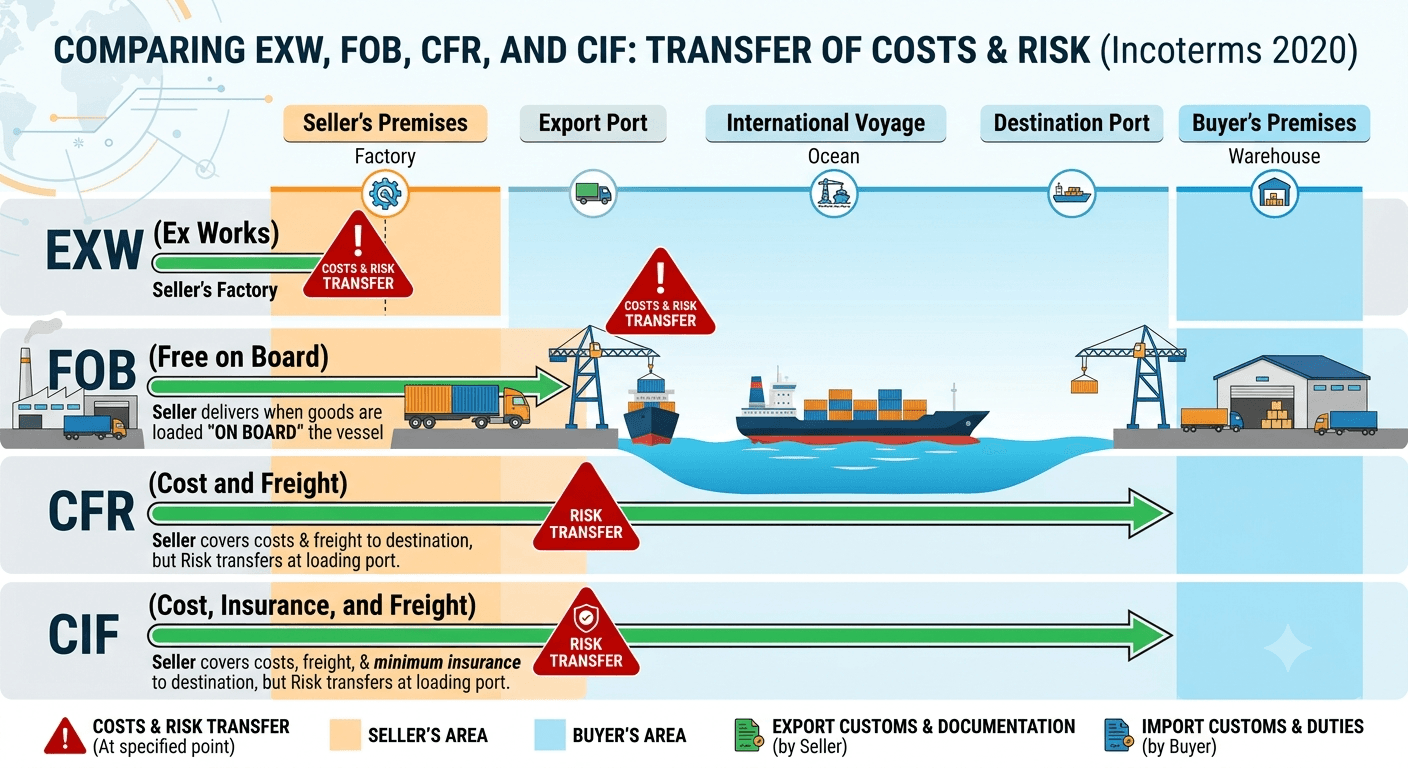
Buying from overseas involves more than agreeing on a product price. Before placing an order, buyers also need to understand who is responsible for shipping, insurance, customs procedures, and the risk if something happens during transit.
This is where Incoterms® come in.
For first-time importers, knowing the differences between EXW, FOB, CFR, and CIF can help prevent unexpected costs and make communication with suppliers much clearer.
What Are Incoterms?
Incoterms® (International Commercial Terms) are standardized trade rules published by the International Chamber of Commerce (ICC). They define the responsibilities of buyers and sellers throughout an international shipment.
They specify:
- Where delivery takes place
- Who pays for transportation
- Who handles customs procedures
- When the risk transfers from seller to buyer
However, Incoterms do not determine ownership of the goods, payment terms, or product quality. Those matters must be agreed separately in the sales contract.
EXW (Ex Works)
With EXW, the seller’s responsibility ends once the goods are made available at the factory or warehouse.
From that point onward, the buyer is responsible for:
- Collecting the goods
- Export procedures
- International freight
- Insurance
- Import customs clearance
- Final delivery
Because the buyer manages nearly every stage of the shipment, EXW is generally better suited to companies that already have established logistics partners and experience with international trade.
Example: A coffee producer in Bandung prepares the order at its warehouse. The buyer arranges pickup and manages the shipment from there to its final destination.
FOB (Free On Board)
Under FOB, the seller arranges transport to the port, completes export customs clearance, and loads the goods onto the vessel.
Once the cargo is safely onboard, the risk transfers to the buyer.
The buyer then takes responsibility for:
- Ocean freight
- Cargo insurance
- Import customs clearance
- Delivery after arrival
FOB is one of the most widely used Incoterms in international commodity trade because it creates a practical balance between buyer and seller responsibilities. For many first-time importers working with a freight forwarder, it is often the most straightforward option.
CFR (Cost and Freight)
With CFR, the seller pays the cost of transporting the goods to the destination port.
Even so, the transfer of risk does not change. The buyer assumes the risk as soon as the goods are loaded onto the vessel at the port of origin.
The buyer remains responsible for:
- Cargo insurance
- Import customs clearance
- Destination charges
- Inland transportation after arrival
This is an important distinction. Paying for freight does not mean the seller continues to bear the shipping risk throughout the voyage.
CIF (Cost, Insurance and Freight)
CIF works much like CFR, with one additional obligation. The seller also arranges the required minimum marine insurance for the shipment.
The buyer is still responsible for:
- Import duties and taxes
- Customs clearance
- Port handling charges
- Delivery from the destination port
Many first-time buyers assume CIF means the goods will be delivered directly to their warehouse. In most cases, that is not correct. The seller’s responsibility generally ends once the shipment reaches the destination port.
Which Incoterm Should You Choose?
There is no single Incoterm that is right for every transaction.
- Choose EXW if you want complete control over logistics and already have reliable shipping arrangements.
- Choose FOB if you want the exporter to manage export procedures while you take control of international shipping.
- Choose CFR if you prefer the seller to arrange ocean freight but intend to handle insurance yourself.
- Choose CIF if you want the seller to organize both freight and the required minimum insurance.
The right choice depends on your experience, your logistics network, and how much responsibility you want to take during the shipping process.
Final Thoughts
A clear understanding of Incoterms helps buyers avoid confusion before a shipment leaves the exporting country. By knowing how EXW, FOB, CFR, and CIF divide costs, responsibilities, and risk, first-time importers can make purchasing decisions with greater confidence.
Before confirming any order, make sure the agreed Incoterm is written clearly in the sales contract, together with the applicable version, such as Incoterms® 2020.